
Which Printing Technology Is Right for Your 2D-Code Application?

Which Printing Technology Is Right for Your 2D-Code Application?
The move towards QR codes, DataMatrix codes and GS1-powered 2D codes is creating new demands for industrial coding equipment.
Unlike a straightforward batch number or expiry date, a 2D code can contain a significant amount of data within a relatively small area. Its individual dots or modules must be printed accurately, with sufficient contrast and consistency for the code to scan throughout production, distribution and retail.
Choosing the right technology therefore depends on more than whether a printer can produce a QR code.
Manufacturers need to consider:
- Packaging material
- Code size and data content
- Production speed
- Available print area
- Product movement and positioning
- Required code durability
- Production environment
- Whether each code must contain unique data
- Inspection and verification requirements
The official GS1 2D Barcodes at Retail Point-of-Sale Implementation Guideline advises manufacturers to consider the substrate, print resolution, barcode size, production speed, product handling, environmental conditions and quality-control requirements when selecting a printing method.
Thermal inkjet printing
Thermal inkjet, or TIJ, is a strong option where manufacturers require high-resolution variable coding within a compact production-line installation.
TIJ can produce sharp text, graphics, linear barcodes and 2D codes. Cartridge-based systems are generally clean and straightforward to operate, with cartridges replaced when the ink is depleted.
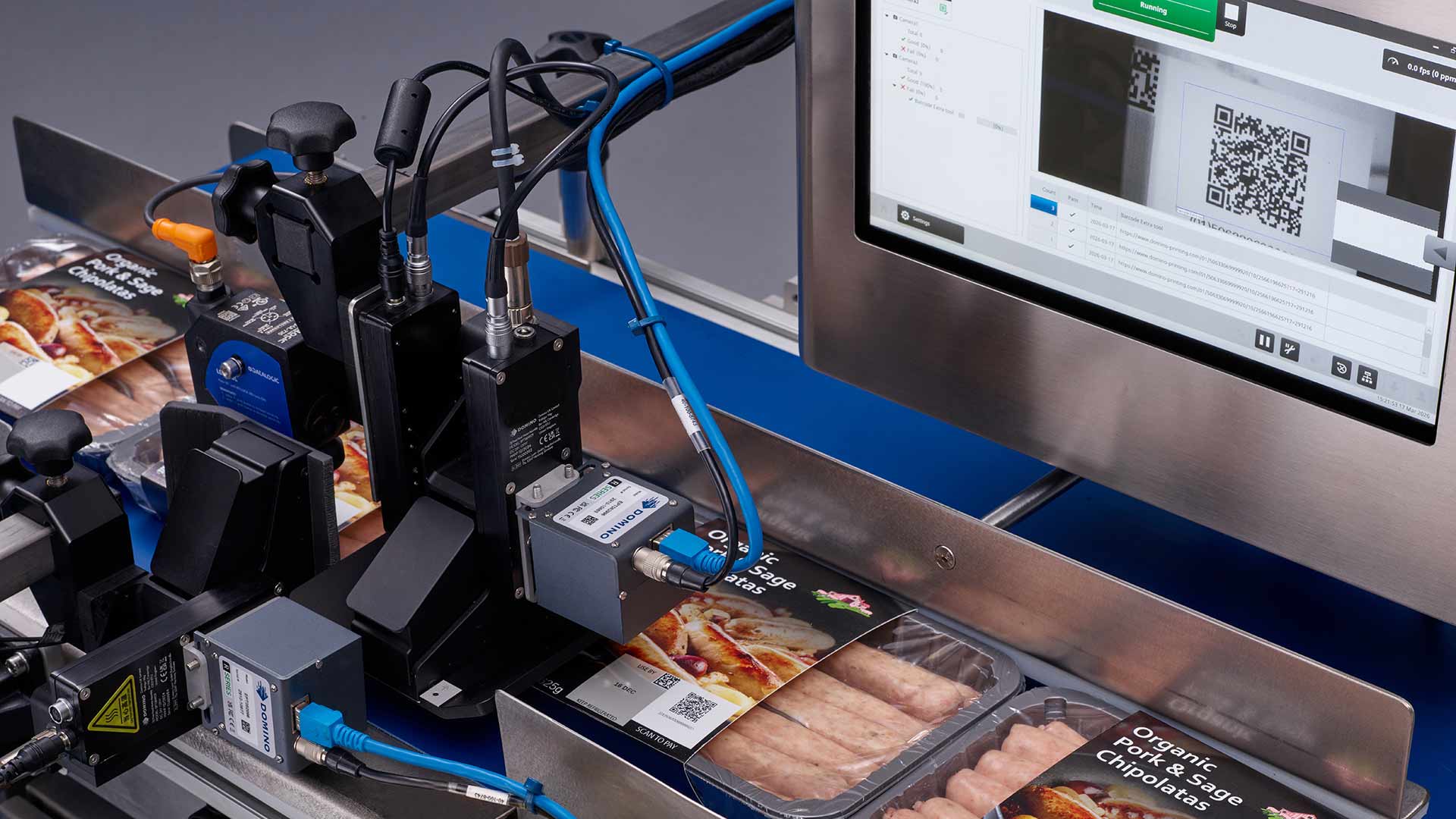
TIJ may be suitable for:
- Cartons and paper-based packaging
- Labels and sleeves
- Trays and cases
- Selected plastics and films
- High-resolution QR and DataMatrix codes
- Applications using frequently changing or serialised data
According to the GS1 implementation guideline, common TIJ resolutions include 300, 600 and 1200 dpi. GS1 also notes that TIJ is commonly used on flat surfaces because the ink droplets travel only a short distance between the printhead and the packaging.
Domino’s Gx-Series PRO, for example, is designed to produce high-resolution, GS1-compliant 2D codes. It offers a print resolution of up to 1200 dpi and a print height of up to 23mm from one printhead. Actual code quality and achievable production speed depend on the selected resolution, ink, code design, substrate and installation conditions.
Product handling and ink selection are particularly important with TIJ. The packaging must pass the printhead at a controlled distance and orientation. Ink adhesion and drying time must also be assessed on non-porous substrates.
GS1 notes that small TIJ ink droplets can be affected by air currents or static electricity. Contact with the printed surface before the ink has dried can also cause smearing.
TIJ is generally best suited to manufacturers requiring compact, high-resolution coding on well-controlled packaging lines.
Continuous inkjet printing
Continuous inkjet, or CIJ, is one of the most versatile industrial coding technologies.
Because CIJ printing is non-contact, it can code products moving at speed and accommodate flat, curved, uneven or irregular surfaces. A broad range of inks is available for different substrates, colours, drying requirements and production environments.
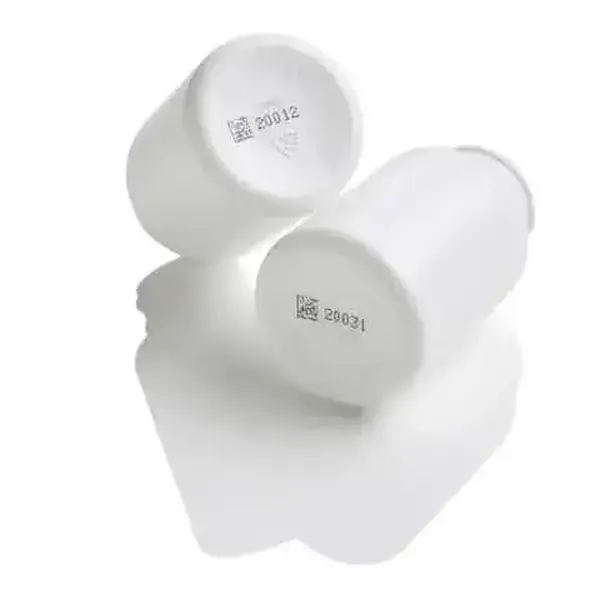
CIJ may be suitable for:
- Bottles, cans and containers
- Curved or uneven products
- Wet, dusty or demanding production environments
- Fast-moving production lines
- Packaging requiring specialist or highly durable inks
- Applications where the product cannot pass extremely close to the printer
CIJ can produce 2D codes, but it normally operates at a lower resolution than TIJ, laser or high-resolution digital inkjet. This may limit how small or data-dense the code can be, particularly as production speed and code height increase.
The GS1 implementation guideline states that maximum CIJ print speed is influenced by the height of the 2D code. It also notes that dot-placement quality can become more difficult to maintain at greater jet deflection.
Printer maintenance is another important consideration. GS1 states that misaligned printheads and dirty jets will not print reliably.
GS1 identifies the following advantages of CIJ:
- Versatility and modular system designs
- Relatively limited integration effort
- Ink adhesion options for the majority of commonly used substrates
CIJ is generally strongest where production-line flexibility, substrate variety and environmental resilience matter more than producing an extremely small or highly data-dense code.
Laser marking
Laser marking creates a code by changing the surface of the packaging rather than depositing printing ink onto it.
Depending on the laser wavelength and packaging material, it can produce permanent, high-contrast codes without using ink cartridges or printing fluids. This removes concerns about ink drying and smudging, while reducing the number of coding consumables required.

Laser may be suitable for:
- Plastic bottles and containers
- Films and flexible packaging
- Cartons, paper and labels
- Glass
- Metal packaging
- Applications requiring permanent or tamper-resistant codes
- High-speed production with limited coding consumables
- Packaging where ink adhesion is difficult
There is no single laser technology suitable for every substrate.
The GS1 implementation guideline states that laser-marking performance depends on the laser wavelength, power, lens and the reaction of the packaging material. It also notes that there is no ideal laser wavelength that works on every substrate.
Domino provides CO₂, fibre and UV laser technologies, with each designed for different materials and applications.
For example, Domino’s Ux360i UV laser has been developed for high-quality variable coding, including GS1-compliant 2D codes, on modern packaging materials such as mono-plastics and thin films.
Laser installations also require appropriate safety guarding and extraction. Lasering a packaging material can generate fumes and debris, while the installation must prevent access to hazardous laser radiation. Domino provides further guidance on laser-system safety and extraction for laser-coding installations.
Laser is generally best suited to manufacturers requiring permanent, high-quality codes on materials that have been proven to respond consistently to the selected laser technology.
High-resolution digital inkjet printing
High-resolution digital inkjet systems are designed for applications requiring a wider print area, very high print quality or large volumes of variable information.
Unlike smaller line-side coders, these systems can print extensive variable content across labels, flexible materials, foils and pre-printed packaging. They may be installed within a packaging-conversion line or used for inline or near-line late-stage customisation.
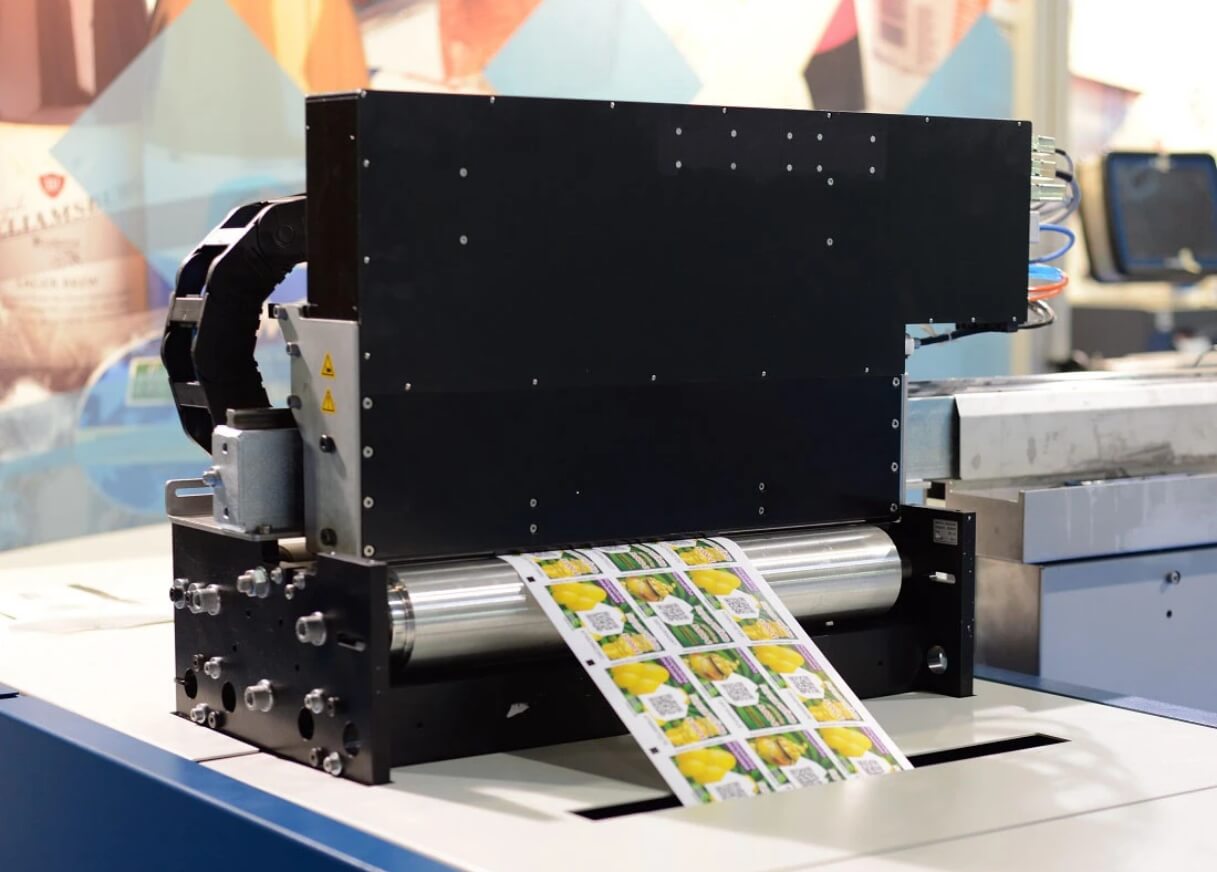
High-resolution digital inkjet may be suitable for:
- Labels and packaging webs
- Blister foils and medical papers
- Large or multiple 2D codes
- Item-level serialisation
- Late-stage packaging customisation
- High-volume variable-data printing
- Applications requiring codes across a wider print area
Domino’s K300 monochrome inkjet printer can apply high-resolution variable data and GS1-compliant 2D codes to web- or sheet-fed labels and packaging.
It offers print capability of up to 600 dpi and maximum line speeds of up to 250 metres per minute, depending on the selected resolution and application.
The official K300 product brochure specifies:
- Up to 250 metres per minute at 600 × 300 dpi
- Up to 125 metres per minute at 600 × 600 dpi
This distinction is important because the maximum resolution and maximum line speed are not necessarily achieved simultaneously.
High-resolution digital inkjet can offer greater print width and data flexibility than a traditional production-line coder. However, it generally requires a more substantial integration project and may be most appropriate for packaging converters, pharmaceutical applications or high-volume late-stage customisation.
High-resolution digital inkjet is generally strongest where print width, serialisation, code quality and large-scale variable-data requirements justify a more integrated solution.
There is no single best technology
The same 2D code may print successfully using one technology on a carton but perform poorly when applied to a glossy film, curved bottle or recycled-content plastic.
The correct solution depends on the complete application.
| Application requirement | Technology commonly considered |
|---|---|
| High-resolution codes on controlled cartons or packs | TIJ |
| Irregular products or demanding environments | CIJ |
| Permanent coding without printing ink | Laser |
| Wide-area, high-volume variable-data printing | High-resolution digital inkjet |
This comparison should only be treated as an initial guide. Printer specifications alone cannot confirm whether a code will remain readable under genuine production conditions.
Test at full production speed
Before selecting a coding technology, manufacturers should complete a production-representative trial using:
- The final packaging material
- The intended code content and size
- Normal and maximum production speeds
- Genuine product handling and positioning
- Expected environmental conditions
- The proposed ink, laser configuration or digital-print settings
The printed code should then be assessed for:
- Data accuracy
- Readability
- Contrast
- Module or dot consistency
- Correct positioning
- Durability throughout the expected product lifecycle
GS1 recommends barcode verification because an ordinary scanner may successfully read a code without identifying underlying quality issues that could cause failures elsewhere in the supply chain.
Two-dimensional codes should be graded against ISO/IEC 15415 using a barcode verifier compliant with ISO/IEC 15426-2. GS1 explains these requirements in its guidance on measuring the quality of printed barcodes.
Inline vision inspection should also be considered where every code needs to be checked for presence, position, readability or correct variable data. However, inline inspection and formal barcode verification perform different functions and should not automatically be treated as interchangeable.
Start with the application, not the printer
The right question is not simply:
Which printer can produce a 2D code?
It is:
Which technology can produce the correct code on the required packaging, at full production speed, with consistent quality throughout the product’s lifecycle?
The final technology decision should follow a representative substrate and production-speed trial, rather than relying on a specification sheet alone.
Codico can assess your packaging material, code requirements and production environment before conducting a representative print and inspection trial.
Contact Codico to discuss your 2D-code application or arrange a live demonstration using your own packaging materials.